

The 2026 outlook
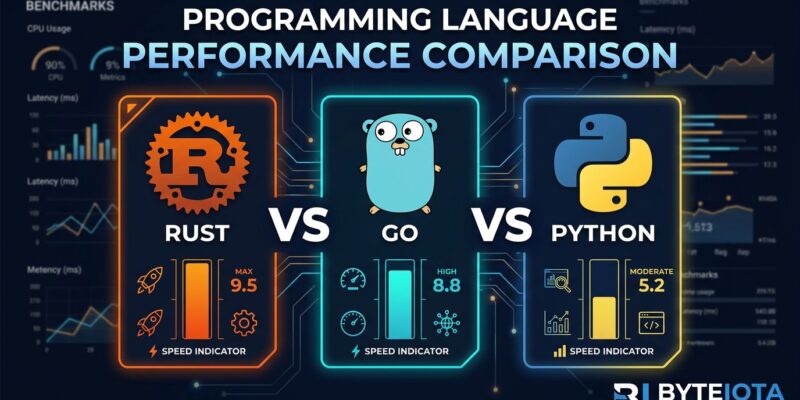
Choosing a language to learn for 2026 comes down to three heavy hitters: Rust, Go, and Python. While new tools pop up every month, these three have carved out specific territories in systems, cloud, and AI that make them safe bets for any developer's career.
Several trends are driving the demand for each. Rust’s focus on safety and performance makes it increasingly valuable in systems programming and embedded systems. Go, designed for concurrency and scalability, is a natural fit for cloud infrastructure. And Python, with its ease of use and extensive libraries, remains the dominant force in data science and machine learning. It's easy to get lost in the sheer number of options, which is why I'm focusing on these three.
I've picked these three because they solve the most pressing problems in modern engineering: memory safety, massive concurrency, and rapid AI deployment. My perspective is shaped by how these ecosystems have matured over the last decade and where the hiring capital is actually flowing.
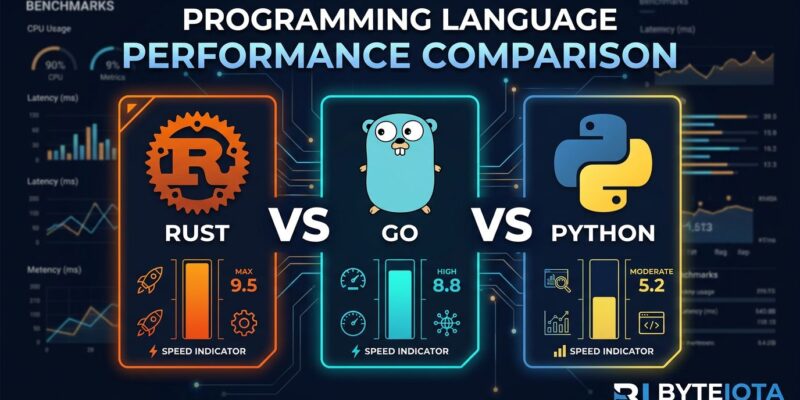
Rust: performance without the crashes
Rust is a relatively new language, first appearing in 2010, but it’s quickly gaining traction among developers who prioritize performance and safety. Its core philosophy revolves around preventing memory-related errors – things like dangling pointers and data races – without relying on a garbage collector. This is a significant departure from languages like Python and Go, which both use garbage collection.
The key to Rust’s safety is its ownership system. Every value in Rust has an owner, and there can only be one owner at a time. When the owner goes out of scope, the value is dropped, and its memory is freed. Borrowing allows you to access data without taking ownership, but with strict rules to prevent data races. Lifetimes ensure that references are always valid. These concepts can be challenging to grasp initially, and Rust definitely has a steeper learning curve than Python or Go.
Despite the complexity, the benefits are substantial. Rust’s performance is comparable to C and C++, making it ideal for systems programming, game development, and embedded systems. Companies like Mozilla (Servo browser engine) and Dropbox have adopted Rust for performance-critical components. It’s also becoming popular in blockchain development and WebAssembly.
The trade-off is that writing Rust code often requires more upfront planning and attention to detail. The compiler is very strict and will reject code that doesn’t adhere to its safety rules. This can be frustrating at first, but it ultimately leads to more robust and reliable software. It's a language that demands precision, and rewards it with speed and security.
Go: built for the cloud
Go, often referred to as Golang, was designed at Google to address the challenges of building large-scale network services. Its creators prioritized simplicity, concurrency, and efficiency. Unlike Rust, Go does use garbage collection, but it's designed to be low-latency and minimize pauses.
A defining feature of Go is its support for concurrency through goroutines and channels. Goroutines are lightweight, concurrently executing functions, and channels are typed pipes that allow goroutines to communicate with each other. This makes it easy to build highly scalable and responsive applications. Go’s approach to concurrency is considered one of its strongest features.
Go is heavily used in cloud infrastructure projects like Docker and Kubernetes. Its simplicity and efficiency make it well-suited for building microservices and other distributed systems. Google itself uses Go extensively in many of its internal projects. Error handling in Go is explicit – functions return multiple values, including an error value, which must be checked by the caller.
One area where Go has historically lagged behind other languages is generic programming. While generics were added in Go 1.18, the support is still relatively limited compared to languages like Rust or C++. This can sometimes lead to code duplication, but the Go community is actively working to address these limitations.
- Goroutines are lightweight functions that run concurrently, allowing you to handle thousands of tasks without the overhead of traditional threads.
- Channels act as typed pipes that let those goroutines talk to each other safely, preventing the usual mess of shared memory.
- Explicit Error Handling: Functions return error values that must be checked.
Rust, Go, and Python: A Comparative Overview (as of late 2023/early 2024)
| Characteristic | Rust | Go | Python |
|---|---|---|---|
| Memory Management | Manual (ownership, borrowing, lifetimes) | Garbage Collected | Garbage Collected |
| Concurrency Model | Fearless Concurrency (ownership prevents data races), threads | Goroutines and Channels | Async/Await (introduced in recent versions), threads |
| Error Handling | Result type for recoverable errors, Panic for unrecoverable errors | Multiple return values (often including an error) | Exceptions |
| Learning Curve | Steep | Moderate | Easy |
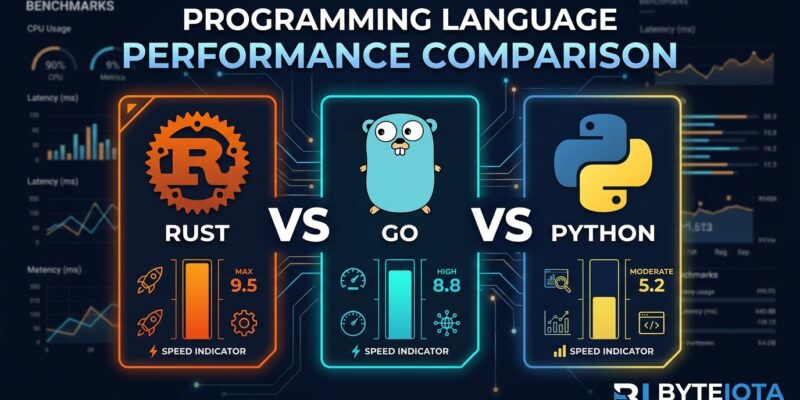
| Performance | Generally very high, comparable to C/C++ | High, efficient compilation | Generally slower than Rust or Go due to interpreted nature |
| Typical Use Cases | Systems programming, embedded systems, performance-critical applications | Cloud infrastructure, networking, distributed systems | Data science, machine learning, scripting, web development |
| Community & Ecosystem | Growing, strong focus on correctness and safety | Large and active, well-supported by Google | Very large and mature, extensive libraries and frameworks |
Illustrative comparison based on the article research brief. Verify current pricing, limits, and product details in the official docs before relying on it.
Python: Versatility and a Huge Ecosystem
Python consistently ranks among the most popular programming languages, and for good reason. Its readability, combined with a massive ecosystem of libraries and frameworks, makes it a versatile choice for a wide range of applications. It's often praised for its gentle learning curve, making it a great language for beginners.
Python excels in data science, machine learning, and artificial intelligence. Libraries like NumPy, Pandas, and TensorFlow provide powerful tools for data analysis and model building. It’s also widely used in web development with frameworks like Django and Flask, and for scripting and automation tasks. Its dynamic typing allows for rapid prototyping and experimentation.
However, Python’s dynamic typing and interpreted nature come with a performance cost. It’s generally slower than compiled languages like Rust and Go. This isn’t always a problem – for many applications, the performance difference is negligible. But for computationally intensive tasks, it can be a bottleneck. Often, developers mitigate this by using optimized libraries (many of which are written in C or C++) or by offloading performance-critical tasks to other languages.
Despite its performance limitations, Python’s ease of use and extensive ecosystem make it an incredibly productive language. It’s a great choice for projects where development speed and maintainability are more important than raw performance.
Jobs and salaries
The job market for all three languages is strong, but demand varies depending on location and specific skillset. According to Stack Overflow’s 2023 Developer Survey, Python remains the most popular language overall, with a large percentage of professional developers using it. Go is also gaining popularity, particularly in back-end development and DevOps roles.
Indeed and LinkedIn data consistently show a high number of job postings for Python developers, particularly those with experience in data science and machine learning. Rust, while having a smaller overall job market, commands a premium salary due to its specialized skillset and the demand for performance-critical applications. It’s important to note that these numbers fluctuate.
As of late 2023/early 2024, average salaries in the US for these languages generally fall in the following ranges (these are estimates and can vary significantly): Python developers earn around $120,000 - $160,000 per year; Go developers earn around $140,000 - $180,000 per year; and Rust developers can earn $160,000 - $220,000 or more. Location plays a huge role – salaries in major tech hubs like San Francisco or New York are typically higher.
These figures are averages. A senior Rust engineer in San Francisco is obviously going to outearn a junior Python dev in a smaller market. Your specific niche—like high-frequency trading or AI infrastructure—matters more than the base language alone.
Essential Books for Mastering Rust, Go, and Python in 2026

Official guide to Rust · Covers core concepts and advanced features · Updated for the latest Rust version
This official guide is essential for understanding Rust's unique approach to safety and performance.

Authored by Go's creators · Explains Go's design philosophy · Covers concurrency and standard library
Learn Go directly from its creators, gaining deep insights into its design and capabilities.

Project-based learning · Covers fundamentals and practical applications · Includes exercises and real-world projects
This popular book offers a fast-paced, project-driven approach to mastering Python for beginners.

Example-driven learning · Focuses on building practical applications · Covers concurrency and robustness
Build confidence in Rust by working through practical examples and creating robust applications.

Classic text on C programming · Authored by Brian Kernighan and Dennis Ritchie · Covers fundamental C concepts
While not a primary focus for 2026, understanding this foundational text provides crucial context for many modern languages.
As an Amazon Associate I earn from qualifying purchases. Prices may vary.
Picking the right tool
Choosing the right language depends heavily on the specific project requirements. If you're building an operating system kernel or a game engine where precise control over memory and performance is paramount, Rust is the clear choice. It's also excellent for embedded systems and applications where safety is critical.
For cloud infrastructure, microservices, and network services, Go is a strong contender. Its concurrency features and efficiency make it well-suited for building scalable and reliable systems. If you’re working with Docker or Kubernetes, Go is almost essential.
If you need a versatile language for data science, machine learning, web development, or scripting, Python is an excellent option. Its extensive libraries and ease of use make it a productive choice for a wide range of tasks. If you need to quickly prototype an idea, Python is hard to beat.
Consider these scenarios: building a high-frequency trading system? Rust. Creating a REST API for a mobile app? Go. Automating system administration tasks? Python. Developing a machine learning model for image recognition? Python. The key is to align the language’s strengths with the project’s needs.
Community and Learning Resources
All three languages have active and supportive communities. Python boasts the largest and most established community, with a wealth of online resources, tutorials, and meetups. Go’s community is known for its pragmatism and focus on simplicity, while Rust’s community is highly engaged and passionate about safety and performance.
Official documentation is excellent for all three languages. For Python, resources like Real Python and the Python Software Foundation website are invaluable. Go has a comprehensive official website with tutorials and examples. The Rust Programming Language book (available online) is considered the definitive guide to learning Rust. Online courses on platforms like Coursera and Udemy are also available for all three languages.
IDEs and tools are readily available. Visual Studio Code is a popular choice for all three, with excellent support for debugging and code completion. IntelliJ IDEA also offers strong support for Go and Python. The Rust community has developed its own dedicated IDE, RustRover, and the Cargo package manager simplifies dependency management.
No comments yet. Be the first to share your thoughts!