

how kubernetes networking works
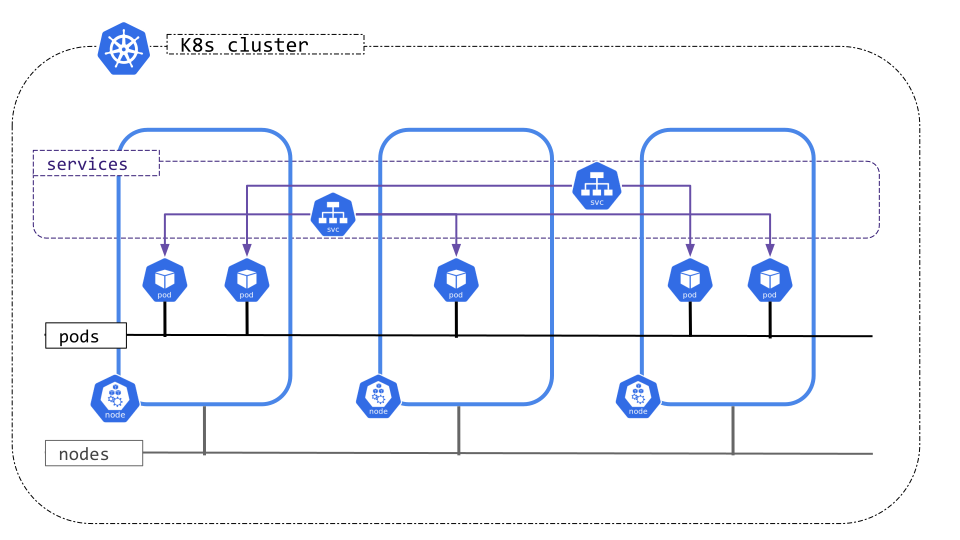
When you move to Kubernetes, you’re not just deploying applications; you’re fundamentally changing how those applications communicate. Traditional networking relies on static IP addresses and pre-defined network configurations. This approach doesn’t translate well to the dynamic, ephemeral nature of containers. Kubernetes networking solves the problem of how Pods – the smallest deployable units in Kubernetes – find each other and connect to services outside the cluster.
The limitations of traditional networking become immediately apparent when you start scaling applications with Kubernetes. Each Pod gets its own IP address, but these IPs are not static. As Pods are created and destroyed, IP addresses change, making it difficult to maintain reliable connections. This is where Kubernetes networking concepts like Pod networking, Service networking, and Ingress come into play. They abstract away the underlying complexity and provide a consistent way to manage network traffic.
Pod networking handles communication between Pods within the cluster. Service networking provides a stable endpoint for accessing a set of Pods, even as their IPs change. Ingress manages external access to these Services, routing traffic from outside the cluster to the correct Pods. The core shift in thinking isn’t about how networking works, but that it works reliably despite constant change. You need to embrace the idea of dynamic networking and declarative configuration.
The goal is to separate your application logic from the physical wires and switches. When you stop worrying about specific IP addresses, you can deploy faster, though it takes a few weeks to get used to the mental shift of dynamic routing.
choosing a cni plugin
The Container Networking Interface (CNI) is the standard for how Kubernetes talks to network providers. It keeps the system modular so you aren't locked into one vendor. It handles the heavy lifting of setting up namespaces and routing rules every time a pod starts up.
Kubernetes doesn’t handle the actual networking implementation itself; it delegates that responsibility to CNI plugins. When you create a Pod, Kubernetes calls the configured CNI plugin to set up the network for that Pod. This modular design allows you to choose the networking solution that best fits your needs and environment. Understanding CNI is important because the choice of plugin significantly impacts network performance, security, and complexity.
Several popular CNI plugins are available, each with its unique approach. Calico uses a policy-based networking model, providing fine-grained control over traffic flow and security. Flannel creates an overlay network, simplifying cluster networking but potentially adding overhead. Cilium leverages eBPF for advanced networking and security features, offering high performance and observability. Weave Net is another popular option, known for its ease of use and automatic network configuration.
These plugins differ significantly in their architectures. Some, like Flannel, establish overlay networks, encapsulating traffic within UDP packets. Others, like Calico, rely on routing and network policies. Cilium uses eBPF, a powerful technology that allows you to run sandboxed programs in the Linux kernel, enabling advanced networking functionalities. The best choice depends on your specific requirements and the scale of your deployment.
- Calico uses BGP to manage fine-grained security policies.
- Flannel: Simple overlay network, easy to set up.
- Cilium: eBPF-based networking, high performance and security.
- Weave Net: Easy to use, automatic network configuration.
CNI Plugin Comparison - 2026
| Network Model | Policy Enforcement | Performance Characteristics | Complexity |
|---|---|---|---|
| Calico | Rich network policy support, including namespace isolation and application-aware policies | Generally high performance, especially with BGP peering. Can be resource intensive. | Higher - Requires understanding of network policy concepts and potentially BGP. |
| Flannel | Simple overlay network. Typically uses VXLAN. | Good for basic networking, but can have performance overhead due to encapsulation. | Lower - Relatively easy to set up and maintain, suitable for smaller deployments. |
| Cilium | eBPF-based networking. Enables advanced networking, security, and observability. | Excellent performance due to eBPF. Offers features like service mesh integration. | Medium to High - Requires understanding of eBPF concepts. Can be more complex to troubleshoot. |
| Weave Net | Overlay network, often using VXLAN. Focuses on ease of use and portability. | Moderate performance. Can be suitable for development and testing environments. | Lower - Simple to deploy and manage, but may lack advanced features. |
| Canal | Combines Flannel's simplicity with Calico's network policy. | Offers a balance between performance and policy control. Utilizes VXLAN. | Medium - Easier to configure than Calico, but more feature-rich than Flannel. |
| Kube-router | Uses standard Linux routing and iptables rules. No overlay network. | Potentially very high performance, as it avoids encapsulation overhead. | Medium - Requires familiarity with Linux networking and iptables. |
Qualitative comparison based on the article research brief. Confirm current product details in the official docs before making implementation choices.
connecting services internally
Kubernetes Services are an abstraction that provides a stable endpoint for accessing a set of Pods. As mentioned earlier, Pod IPs are ephemeral. Services solve this problem by providing a single, persistent IP address and DNS name that clients can use to connect to a group of Pods. This allows you to scale your applications without having to update client configurations every time a Pod is created or destroyed.
There are three main types of Kubernetes Services: ClusterIP, NodePort, and LoadBalancer. ClusterIP is the default type and exposes the Service on an internal IP address within the cluster. This is suitable for applications that only need to be accessed by other Pods within the cluster. NodePort exposes the Service on a specific port on each node in the cluster, allowing external access via the node's IP address. LoadBalancer provisions an external load balancer (if supported by your cloud provider) to distribute traffic to the Service.
DNS resolution is a critical part of Service functionality. Kubernetes automatically creates DNS records for each Service, allowing Pods to discover and connect to each other using their Service names. This simplifies application communication and eliminates the need for manual configuration. Service discovery is seamless; Pods can resolve Service names to IP addresses without any special configuration.
Each service type has its limitations. ClusterIP is only accessible from within the cluster. NodePort requires you to manage port conflicts and exposes your nodes directly. LoadBalancer can be expensive and is dependent on your cloud provider's capabilities. Choosing the right service type depends on your application’s access requirements and the infrastructure you’re working with.
Ingress Controllers: Exposing Applications Externally
While Services handle internal communication within the Kubernetes cluster, Ingress Controllers manage external access to those Services. An Ingress Controller acts as a reverse proxy, routing external traffic to the appropriate Service based on defined rules. It’s a more sophisticated way to expose applications than using NodePort or LoadBalancer directly.
Ingress resources define the routing rules. These rules specify how external traffic should be routed to different Services based on factors like hostnames and URL paths. For example, you can configure an Ingress resource to route traffic to a different Service based on the requested domain name. This allows you to host multiple applications on a single Kubernetes cluster using a single external IP address.
Several popular Ingress Controllers are available, each with its own strengths and weaknesses. NGINX Ingress Controller is a widely used option, known for its performance and flexibility. Traefik is a cloud-native Ingress Controller that automatically configures itself based on your Kubernetes resources. HAProxy Ingress Controller provides high availability and load balancing capabilities.
Ingress Controllers also handle TLS termination, encrypting traffic between clients and the cluster. They support virtual hosting, allowing you to host multiple domains on a single Ingress Controller. Configuring Ingress requires defining Ingress resources with specific routing rules and TLS settings. While complex, it offers a powerful and flexible way to manage external access to your applications.
Content is being updated. Check back soon.
securing traffic with network policies
By default, every pod in your cluster can talk to every other pod. That's usually a bad idea for security. Network policies let you lock this down, ensuring only the services that need to talk to each other actually can.
Network Policies work by defining rules that control traffic flow based on selectors. Selectors are labels that you apply to Pods. A Network Policy can specify that Pods with a certain label can only communicate with Pods that have another specific label. This allows you to create fine-grained security rules based on application roles and dependencies.
Network Policies define both ingress and egress rules. Ingress rules control incoming traffic to a Pod, while egress rules control outgoing traffic from a Pod. You can use these rules to restrict access to sensitive resources and prevent unauthorized communication. Implementing Network Policies requires a CNI plugin that supports them, such as Calico or Cilium.
Security is often an afterthought in Kubernetes deployments, but Network Policies are a powerful tool for mitigating risks. They help you enforce the principle of least privilege, ensuring that Pods only have access to the resources they need. Regularly reviewing and updating your Network Policies is essential to maintain a secure Kubernetes environment.
- Identify the pods you want to isolate using labels.
- Create ingress rules: Control incoming traffic.
- Create egress rules: Control outgoing traffic.
- Test policies: Verify that they are working as expected.
Advanced Networking Concepts: Service Mesh and Beyond
As Kubernetes networking matures, advanced technologies like Service Meshes are gaining popularity. A Service Mesh is a dedicated infrastructure layer for handling service-to-service communication. Technologies like Istio and Linkerd provide features like traffic management, observability, and security without requiring changes to your application code.
Service Meshes offer benefits beyond basic networking. They enable traffic shaping, allowing you to control the flow of traffic between services. They support fault injection, allowing you to test the resilience of your applications. They also provide mutual TLS authentication, securing communication between services. These features are difficult to implement manually and are often essential for complex microservices architectures.
Beyond Service Meshes, other advanced networking options are emerging. Multi-cluster networking allows you to connect multiple Kubernetes clusters, creating a unified network across different environments. Network service meshes extend the concept of a Service Mesh to encompass network services like firewalls and load balancers. These technologies represent the future of Kubernetes networking.
The complexity of these advanced concepts shouldn’t be a deterrent. They address critical challenges in large-scale Kubernetes deployments. They provide the tools and infrastructure needed to build and operate resilient, secure, and observable applications. Understanding these concepts is essential for anyone looking to push the boundaries of Kubernetes networking.
Amazon Products for Kubernetes Networking
Amazon Web Services (AWS) offers a range of products that can assist with Kubernetes networking. AWS Network Firewall provides network security for your Kubernetes clusters, protecting against common threats. The VPC CNI plugin for Kubernetes integrates with Amazon Virtual Private Cloud (VPC), simplifying network configuration and management.
Amazon CloudWatch provides monitoring and logging capabilities, allowing you to track network traffic and identify potential issues. AWS Load Balancer Controller automatically provisions and configures load balancers for your Kubernetes Services. These tools can help you build and operate a secure, reliable, and scalable Kubernetes networking infrastructure on AWS.
For more advanced networking, consider AWS App Mesh, a fully managed service mesh. It provides traffic management, observability, and security features for your microservices applications. Integrating these AWS products with Kubernetes can streamline your networking operations and improve the overall performance of your applications.
- AWS Network Firewall: Network security for Kubernetes clusters.
- VPC CNI plugin: Integration with Amazon VPC.
- Amazon CloudWatch: Monitoring and logging.
- AWS Load Balancer Controller: Automatic load balancer provisioning.
- AWS App Mesh: Fully managed service mesh.
Essential Tools for Kubernetes Network Management in 2026

Explores the fundamental networking concepts within Kubernetes. · Details how different network layers interact in a Kubernetes cluster. · Provides insights into building robust and scalable Kubernetes networks.
This book offers a foundational understanding of Kubernetes networking, essential for grasping more advanced concepts.

Focuses on Cilium, a popular eBPF-based networking solution for Kubernetes. · Covers advanced networking, security policy enforcement, and observability features. · Guides users through implementing and managing Cilium in cloud-native environments.
Cilium is a leading solution for modern Kubernetes networking, offering deep visibility and control.
Comprehensive coverage of HashiCorp's ecosystem (Terraform, Vault, Consul, Nomad). · Explains infrastructure automation, multi-cloud provisioning, and secrets management. · Details service mesh implementation using Consul.
This guide provides essential knowledge for automating infrastructure and managing services, which complements Kubernetes network management.

Covers comprehensive observability with Datadog. · Includes APM, logs, metrics, and OpenTelemetry integration. · Details monitoring for Kubernetes, FinOps, and AI-driven insights.
Datadog is a powerful tool for gaining deep visibility into Kubernetes network performance and application behavior.

Acts as a USB protocol analyzer. · Facilitates detailed data analysis of USB traffic. · Compatible with Wireshark for advanced packet inspection.
While not directly Kubernetes-specific, this tool can be invaluable for debugging low-level network issues that might impact Kubernetes nodes or connected devices.
As an Amazon Associate I earn from qualifying purchases. Prices may vary.

No comments yet. Be the first to share your thoughts!