

The state of programming in 2026
The tech job market is shifting. While layoffs made headlines recently, the demand for people who can actually build things remains high. The biggest change isn't just the volume of jobs, but the shift toward AI-integrated workflows. If you're picking a language to learn for 2026, you need to look at how these tools handle modern infrastructure and automation.
AI-assisted coding tools are becoming increasingly sophisticated. GitHub Copilot, Amazon CodeWhisperer, and similar platforms can now generate code snippets, suggest completions, and even write entire functions, changing the day-to-day work of many programmers. This means the ability to quickly learn and adapt to new technologies is more important than ever. Choosing a programming language now isn’t just about landing a job today; it's about future-proofing your skillset.
This environment makes selecting a first language, or adding another to your repertoire, a more significant decision. It’s not enough to simply pick something popular. You need to consider the long-term viability of the language, its community support, and its relevance to the industries you want to work in. We’ll be looking at three major players – Rust, Go, and Python – to help you navigate this landscape.
Python: the king of versatility
Python has long been a favorite among beginners and experienced developers alike, and for good reason. Its readability is a major draw – the syntax is designed to be relatively close to plain English, making it easier to learn and understand. This, combined with a massive and active community, means there's a wealth of resources available for anyone learning the language.
The Python ecosystem is enormous. From data science and machine learning to web development and scripting, there's a library for almost anything you can imagine. Popular choices include NumPy and Pandas for numerical computing and data analysis, TensorFlow and PyTorch for machine learning, and Django and Flask for web application development. This extensive library support significantly speeds up development time.
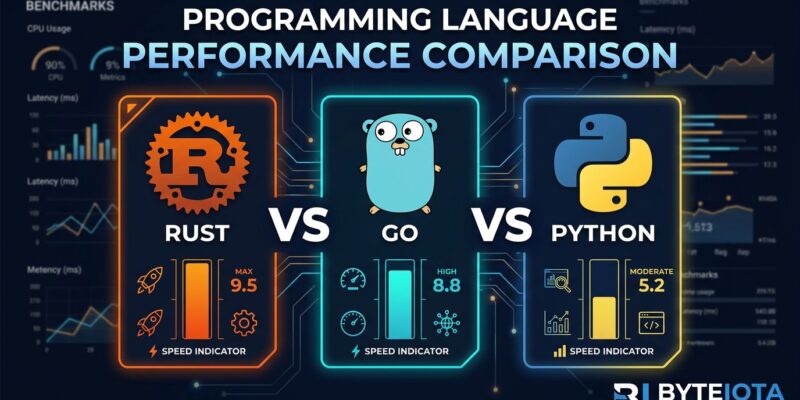
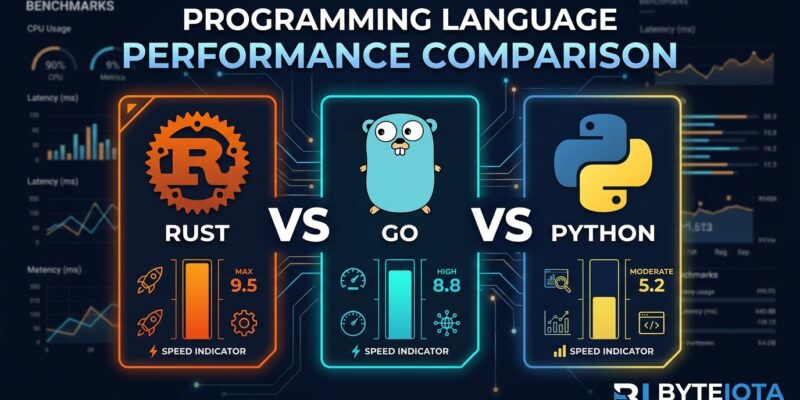
Python is slow. There is no way around it. The Global Interpreter Lock (GIL) is a constant headache for multi-threaded tasks, and while the community is working on 'nogil' builds, you'll still struggle with high-concurrency needs compared to compiled languages. It's a trade-off: you get fast development time in exchange for slower execution.
The rise of AI-assisted coding is both a boon and a potential threat to Python’s dominance. Python is the language of choice for many AI/ML frameworks, meaning these tools integrate seamlessly. But if AI can automate much of the repetitive coding tasks Python excels at, the advantage of its ease of use might diminish. The language is actively adapting, though, with ongoing efforts to improve performance and concurrency.
- NumPy for numerical computing and Pandas for data manipulation
- Pandas: For data analysis and manipulation.
- TensorFlow & PyTorch: Leading machine learning frameworks.
- Django & Flask: Popular web development frameworks.
Go: built for systems
Go, often referred to as Golang, was developed at Google) and emphasizes simplicity, efficiency, and concurrency. It’s designed to be a practical language for building reliable and scalable systems. The creators aimed to address many of the complexities found in other languages, resulting in a relatively clean and straightforward syntax.
One of Go's key strengths is its fast compilation speed. This makes the development process much quicker, especially for large projects. It also features built-in garbage collection, which simplifies memory management, and excellent support for concurrency through goroutines and channels. These features make it well-suited for building high-performance network services.
Go’s ecosystem is smaller than Python’s, but it’s growing rapidly. While it may not have a library for every conceivable task, the available tools are generally well-designed and efficient. Popular frameworks include Gin and Echo for web development. Go is becoming increasingly prominent in cloud infrastructure, with tools like Docker and Kubernetes being written in the language.
Is Go really as simple as its proponents claim? While the core language is relatively small, mastering its concurrency features and understanding its approach to error handling can take time. But overall, it’s a pragmatic language that prioritizes getting things done efficiently. Its adoption in DevOps and backend development is a clear sign of its growing influence.
- Cloud tools like Docker and Kubernetes
- Gin & Echo: Lightweight web frameworks.
- Goroutines & Channels: Built-in concurrency features.
Rust, Go, and Python: A Comparative Overview (2026 Outlook)
| Learning Curve | Performance | Concurrency | Ecosystem Size | Community Support |
|---|---|---|---|---|
| Rust | High | Excellent | Developing | Growing |
| Go | Medium | Very Good | Excellent | Extensive |
| Python | Low | Moderate | Good | Extensive |
Illustrative comparison based on the article research brief. Verify current pricing, limits, and product details in the official docs before relying on it.
Rust: Safety and Performance, at a Cost
Rust is a systems programming language focused on safety, speed, and concurrency. It’s unique in its ability to guarantee memory safety without needing a garbage collector. This is achieved through a system of ownership and borrowing, which prevents common programming errors like dangling pointers and data races.
This focus on safety comes at a cost: Rust has a steep learning curve. Its syntax is more complex than Python or Go, and the ownership system can be challenging to grasp initially. However, the benefits in terms of reliability and performance are significant, particularly for systems-level programming.
Rust is finding increasing use in areas where performance and safety are critical. This includes operating systems, embedded systems, game development, and web assembly. The Rust community has developed a growing collection of crates (Rust’s package manager) to support various tasks, including web development with frameworks like Rocket and Actix-web.
The perception of Rust as being overly difficult is somewhat justified, but the community is actively working to improve the learning experience. The language is becoming more approachable, and the rewards for investing the time to learn it are substantial. It's a language that demands precision, but it also empowers developers to build incredibly robust and efficient software.
The job market for 2026
Analyzing job postings reveals some interesting trends. Python consistently appears in the highest number of job postings overall, reflecting its widespread adoption across various industries. Demand for Python developers remains strong in data science, machine learning, and web development. However, the rate of growth appears to be slowing.
Go is experiencing significant growth in demand, particularly in the cloud computing and DevOps spaces. Companies are increasingly adopting Go for building microservices and infrastructure tools. While the total number of Go jobs is still lower than Python, the percentage increase in demand is notable.
Rust, while still a relatively niche language, is seeing the fastest growth in demand. This is driven by the increasing need for high-performance, secure systems. Although the absolute number of Rust jobs is small compared to Python and Go, the trend is clearly upward. This suggests Rust is becoming a sought-after skill for specialized roles.
It’s important to note that these trends can vary by location and industry. Certain regions may have a higher demand for specific languages. Furthermore, job titles can be misleading – a “Data Scientist” role may require proficiency in Python, but also statistical knowledge and domain expertise.
- Python: Highest total job postings, slowing growth.
- Go: Strong growth in cloud computing and DevOps.
- Rust: Fastest growth, but from a smaller base.
Essential Books for Mastering Rust, Go, and Python in 2026

Comprehensive coverage of Rust's core concepts · Explains Rust's memory safety features · Covers modern Rust practices and idioms
This definitive guide provides a thorough understanding of Rust, essential for mastering its unique approach to safety and performance.

Focuses on idiomatic Go programming practices · Covers practical applications and real-world scenarios · Explains Go's concurrency features
Learn to write clean, efficient, and idiomatic Go code with this practical guide to building real-world applications.

150 fun Python programming projects · Designed for absolute beginners and kids · Aims to teach Python fundamentals in one month
This workbook offers a fun and engaging way for beginners, especially children, to quickly grasp Python fundamentals through hands-on projects.

Explores advanced Rust concepts and techniques · Provides hands-on coding exercises · Aims to enhance existing Rust programming skills
Build upon your foundational Rust knowledge with advanced techniques and practical exercises to elevate your coding proficiency.

Provides practical recipes for common Go tasks · Focuses on efficient and effective solutions · Covers a range of Go programming challenges
This resource offers quick, effective solutions to common Go programming challenges, enabling you to write more efficient code.
As an Amazon Associate I earn from qualifying purchases. Prices may vary.
Community and Support: Where to Find Help
A supportive community is invaluable, especially when learning a new language. Python has one of the largest and most active communities in the world. The Python Software Foundation provides resources and support, and numerous online forums, tutorials, and meetups are available.
The Go community is also vibrant and welcoming. The official Go website offers comprehensive documentation, and the language has a strong presence on Reddit and Slack. Google actively supports the Go community, providing resources and contributing to the development of the language.
Rust’s community is known for being exceptionally helpful and inclusive. The Rust Forum is a great place to ask questions and get assistance. The community is also very active on social media and in online chat channels. Despite the language’s complexity, newcomers are generally greeted with patience and encouragement.
No comments yet. Be the first to share your thoughts!